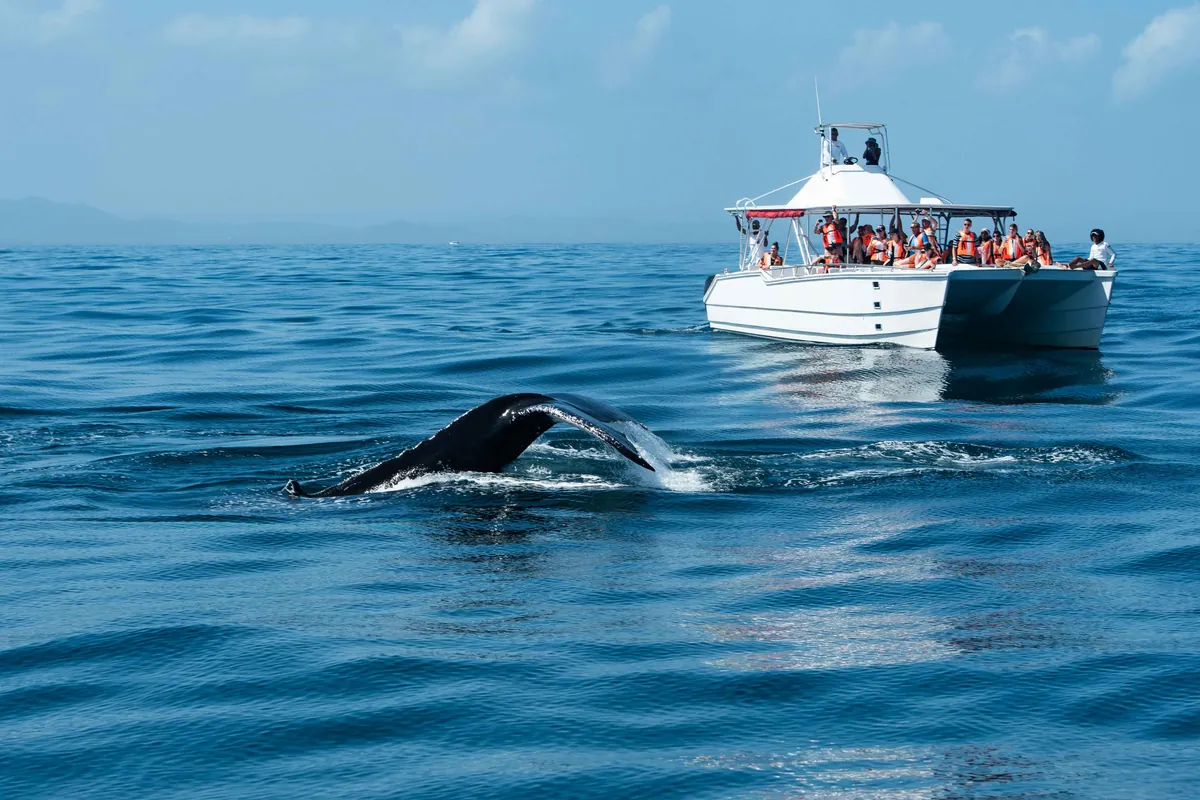
Blue whale fluke in the Sea of Cortez, Baja California Sur

Where to see each whale species.

The 12 species you can see in Blowline's destinations: where they travel through the year, how to recognise them and which guide to find them in.

Where they live and where they travel.

Each illustration is a species, outlined in its region's colour and sized to keep the real order between them. Arrows show the journey to the breeding grounds. Hover to see its name, or tap it to learn what it does there and which guide covers it.

Simplified routes based on WWF's blue corridors map (Johnson et al., 2022), built from satellite tracking, and other scientific sources: they show the general direction of travel, not exact tracks. Each whale can change its route and timing, and no sighting is guaranteed.

Get to know each one.

Baleen whales

Instead of teeth they have baleen: plates they use to filter krill, small crustaceans and fish. They include the largest animals on the planet.

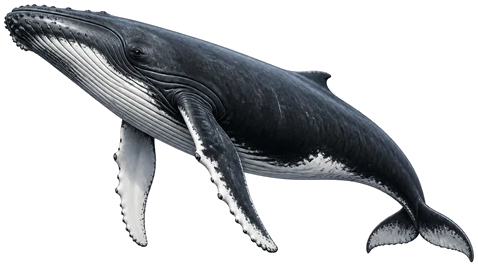
Humpback whale
Megaptera novaeangliae

Baleen whale

Humpback whale

The most acrobatic of the great whales: it breaches, slaps the water with its tail and its remarkably long flippers, and is sometimes curious around boats. On the breeding grounds, males sing long, complex songs. Almost every population migrates each year between cold waters, where it feeds, and warm waters, where it breeds; some travel up to 8,000 km.

Adult size
18 mapprox. maximum length
Conservation (IUCN)
LCLeast Concern
How to recognise it
Very long flippers, knobs on the head and a tail whose underside pattern is unique to each individual.

Where to see it with Blowline

Blue whale
Balaenoptera musculus

Baleen whale

Blue whale

The largest animal that has ever lived. It feeds mainly on krill, engulfing more than 100 tonnes of water in a single lunge. It is usually seen alone or in pairs, and its migrations are still poorly understood.

Adult size
27 mNorthern Hemisphere; largest measured, 33 m
Conservation (IUCN)
ENEndangered
How to recognise it
Its size, a slender body and mottled blue-grey skin; the markings on its flanks and tail identify each individual.

Where to see it with Blowline

Southern right whale
Eubalaena australis

Baleen whale

Southern right whale

It comes very close to the coast to give birth and nurse its calves between July and October, which is why in some destinations it can even be seen from the shore. It is calm, approachable and often acrobatic. Since hunting ended, some populations have grown by up to 7-8% a year.

Adult size
14–18 madult
Conservation (IUCN)
LCLeast Concern
How to recognise it
No dorsal fin, a strongly arched jaw, a V-shaped blow and pale callosities on the head, different on every individual.

Where to see it with Blowline

Gray whale
Eschrichtius robustus

Baleen whale

Gray whale

Its round-trip migration can reach 20,000 km along the Pacific coast of North America, between its Arctic feeding grounds and the Mexican lagoons where calves are born. It is known for approaching boats out of curiosity. It feeds mainly on the sea floor, on small crustaceans.

Adult size
13–15 madult
Conservation (IUCN)
LCLeast ConcernThe western population is Critically Endangered (CR).
How to recognise it
Mottled grey skin and no dorsal fin: a small hump followed by a row of 'knuckles' along the back.

Where to see it with Blowline

Fin whale
Balaenoptera physalus

Baleen whale

Fin whale

The second largest whale, after the blue whale. More streamlined, with a pointed head and a marked ridge between the dorsal fin and the tail. It usually lives in cold offshore waters and its movements are less predictable than other whales'; some populations, such as the one in the Gulf of California, live there year-round.

Adult size
23–26 madult
Conservation (IUCN)
VUVulnerable
How to recognise it
A white lower jaw and pale chevron markings behind the head.

Where to see it with Blowline

Sei whale
Balaenoptera borealis

Baleen whale

Sei whale

The third largest whale, after the blue and fin whales. It lives offshore in temperate and sub-polar waters, and its movements are unpredictable: it may be present in an area one year and absent the next. It feeds at the surface, filtering small crustaceans with its mouth open.

Adult size
12–18 madult
Conservation (IUCN)
ENEndangered
How to recognise it
The tip of the snout turns slightly down, and there is a single ridge on the head (Bryde's whale has three).

Where to see it with Blowline

Minke whale
Balaenoptera acutorostrata

Baleen whale

Minke whale

The smallest and most streamlined rorqual, with a sharply pointed head. It is not known for acrobatics or for approaching boats, and vessels can interrupt its feeding: one more reason to choose operators who keep their distance.

Adult size
11 mapprox. maximum length
Conservation (IUCN)
LCLeast Concern
How to recognise it
Small size, a tall dorsal fin set well forward, and a white band on the flippers.

Where to see it with Blowline

Bryde's whale
Balaenoptera edeni

Baleen whale

Bryde's whale

The tropical whale: it prefers waters above 16 °C, between 40° North and South, and some populations stay in the same area year-round. It eats schooling fish such as sardines and anchovies, and is usually seen alone or in groups of up to three.

Adult size
12–17 madult
Conservation (IUCN)
LCLeast Concern
How to recognise it
Three parallel ridges on top of the head.

Where to see it with Blowline

Toothed whales

They have teeth and hunt prey one by one, guided by sound. The sperm whale is the largest; orcas and pilot whales are, in fact, large dolphins.

Sperm whale
Physeter macrocephalus

Toothed whale

Sperm whale

It has the largest head and brain of any animal. It dives on average to about 800 m for around 50 minutes to hunt squid, so at the surface you usually see it resting and breathing before it dives again, showing its tail. Females and their young live in stable family groups of 4 to 21 animals.

Adult size
12–16 mfemales ~12 m · males ~16 m
Conservation (IUCN)
VUVulnerable
How to recognise it
A blow angled forward and to the left, a square head, wrinkled skin and a small hump instead of a dorsal fin.

Where to see it with Blowline

Orca
Orcinus orca

Toothed whale

Orca (killer whale)

The largest dolphin. It lives in very stable family groups, each with its own repertoire of calls, and at least eight different forms are known, each specialised in different prey: in Norway they follow the herring; in Patagonia they hunt sea lion pups. Found in every ocean, especially in cold waters.

Adult size
10 mapprox. maximum length
Conservation (IUCN)
DDData Deficient
How to recognise it
Unmistakable black and white and, in adult males, a tall, prominent dorsal fin; its shape, its scars and the grey saddle patch behind it identify each animal.

Where to see it with Blowline

Pilot whales Pilot whales
Globicephala melas (long-finned) · Globicephala macrorhynchus (short-finned)

Toothed whale

Pilot whales

A rounded head and a curved dorsal fin, larger and thicker in adult males. They live in stable family groups of 20 to 100 animals, in which males stay with their mother's group for life. The long-finned pilot whale lives in cool-temperate waters (in the Northern Hemisphere, only the North Atlantic and the Mediterranean); the short-finned, in tropical and warm-temperate waters.

Adult size
4–8 mshort-finned 4–7 m · long-finned 6–8 m
Conservation (IUCN)
LCLeast Concern
How to recognise it
The two species look very alike: where you see them is the best clue.

Where to see it with Blowline